

Local Numbers vs Toll-Free Numbers
Choose numbers around how customers reach your business, the coverage you need, and the cost of returning their calls.
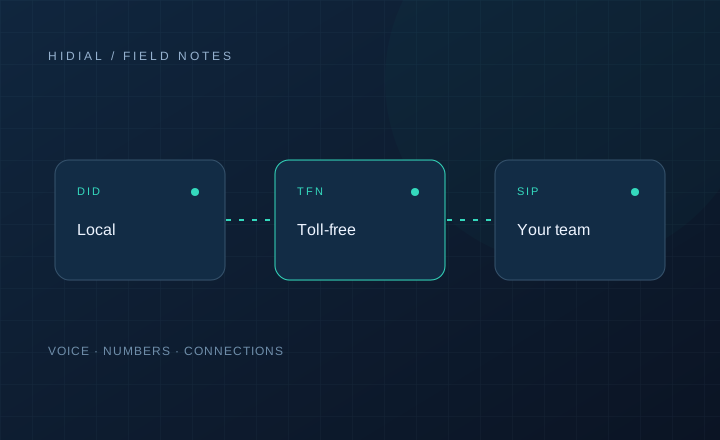
A local number and a toll-free number can both route to the same contact center. The difference is not where your agents sit. It is how the number presents your business to callers, how it can be reached, and how the calling charges are arranged.
Choose the number around the customer’s task. A customer calling a nearby branch may expect a local contact. Someone seeking nationwide support may benefit from one widely published number.
When a local number fits
Local numbers can help organize calls by branch, service area, or regional team. They also let customers return a call to a number associated with a specific part of your business. Keep that association accurate: a local area code should not be used to create a false impression of your location.
Ask about coverage and availability in the locations you serve. A local number does not guarantee that customers will recognize the caller or answer the phone. Test your actual use case instead of assuming that an area code increases trust.
When a toll-free number fits
A toll-free number can provide a central contact for sales, support, or a national campaign. In the standard toll-free arrangement, the called business pays the toll-free call charge rather than the caller. Confirm the reachable territories and pricing with your provider, especially if customers call internationally.
Toll-free prefixes do not, by themselves, tell a customer which branch or region handles the call. If that distinction matters, your IVR and routing need to direct callers to the right team.
Compare the full cost
Compare monthly number rental, usage, forwarding, setup, and any minimum commitments. Inbound traffic volume matters: a number with a low monthly fee can still produce a larger bill when many customers call.
Ask about concurrent inbound calls and how overflow works. Confirm whether callers can wait in a queue, reach voicemail, or be forwarded to another destination. Those details often matter more to customer service than the prefix you choose.
Treat messaging as a separate capability
If you want customers to text the number, ask about messaging support, registration, activation, and who controls that service. Do not assume a voice-enabled number is already text-enabled.
Keep voice and messaging providers coordinated. Somos has highlighted the risk of unauthorized text enablement when services on the same toll-free number are managed separately. Account ownership and change authorization should be explicit.
Make callbacks easy to complete
For outbound campaigns, the displayed number should identify your business accurately and provide an appropriate callback path. Test the inbound route during business hours and after closing. Train agents to explain why they called and handle requests to stop contact.
A toll-free or local number is not a guaranteed way to prevent spam labels. Caller ID authentication, receiving-network analytics, and the customer’s calling experience are separate considerations.
Use both when the roles are different
A business might publish a toll-free number for central support while keeping local numbers for branches. The important part is documenting each number’s purpose and keeping the routing consistent with it.
Contact HiDial with your service areas, expected inbound volume, and callback requirements to discuss number options.