

Business Telecom for Startups: Numbers, Voice, and Compliance From Day One
Set up business-owned numbers, practical call routing, clear account ownership, and basic operating controls before your team grows.
A startup can outgrow its first phone arrangement before it hires a dedicated operations team. A founder's personal number becomes the sales line, customers save it for support, and nobody has decided who handles calls during a meeting or after hours.
A business telecom setup does not need to be complicated on day one. It needs clear ownership, a working call path, and enough documentation that the next person can operate it.
Begin with the calls the business needs
List the reasons someone will call: a sales question, an existing customer issue, a supplier request, or a scheduled consultation. Decide which conversations the team can handle live and which need voicemail or a callback.
Start with routing that fits actual staffing. If one person answers both sales and support, a shared line with clear business hours may be more useful than an IVR offering several unstaffed departments.
Write down what happens when the first person cannot answer. Test the overflow path rather than assuming an unanswered call will reach the right voicemail.
Keep numbers under business control
Use a business-owned account for number provisioning and billing. Document the account owner, authorized administrators, number inventory, and the applications receiving calls.
Choose a local or toll-free number around your customers' needs and the provider's available coverage. An area code does not establish a physical office, and a toll-free number does not automatically make every international caller able to reach it.
Before publishing a number, test it from representative networks and confirm that callers can reach your team. Ask about porting requirements so a future provider change does not depend on access to a former employee's personal account.
Connect the number to the right platform
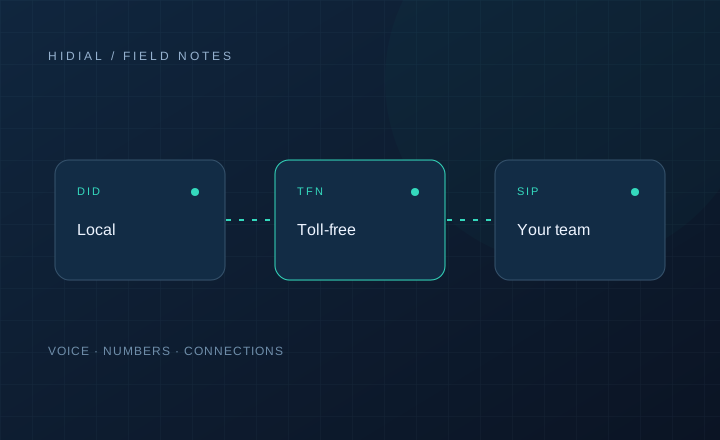
A number, a SIP trunk, and a phone system have different roles. The number identifies the inbound destination, the trunk provides connectivity, and the connected system handles users, queues, IVRs, voicemail, or other application features.
Confirm what the quote actually includes. Do not assume that buying SIP service also supplies a CRM, a browser phone, recording storage, messaging, or emergency calling. Establish a suitable emergency-calling arrangement for the devices and locations your team will use.
Ask for pricing based on your workload
Describe your destination countries, expected usage, number types, and peak simultaneous calls. If you plan to use a dialer or automated notifications, describe that traffic explicitly and ask whether it is permitted.
Compare number rental, usage, billing increments, forwarding, activation charges, contractual minimums, and optional services. Include any overlap needed to migrate an existing line. A low headline rate does not describe the full operating cost.
Establish contact and privacy rules early
Decide who can approve outbound campaigns, where permission records live, and how requests to stop contact reach the systems placing calls. Keep transactional notifications and promotional campaigns identifiable as separate workflows.
For covered US telemarketing, the FTC's guidance addresses Do Not Call obligations and other contacting restrictions. Review the requirements for your actual recipients, technology, and purpose. A customer record or purchased phone list is not a universal authorization to call. FTC guidance.
Set access and retention rules for call records and recordings where used. Collect information that serves a defined purpose and avoid putting unnecessary customer details into routine troubleshooting requests.
Protect the account and plan for staff changes
Give administrators individual access, use stronger authentication where supported, and restrict who can change routing, export records, or use API credentials. Remove access when someone leaves and keep billing ownership current.
Keep a short runbook with the phone provider, number destinations, business-hours rules, escalation contact, and a way to reach customers if the normal platform is unavailable. Review it after material changes rather than waiting for the first outage.
Add complexity when there is a clear need
As the team grows, use missed calls, callback delays, and customer feedback to decide whether you need dedicated numbers, queues, or CRM integration. Keep the connection between each feature and the problem it solves visible.
Contact HiDial with your current setup and expected growth to discuss numbers, SIP connectivity, and routing requirements. Start with a configuration your team can operate and expand it as the workload becomes clearer.
